日英翻訳見本 その(1) バイナリー発電 ― 海洋温度差発電 のページです。
その他の翻訳見本は、以下になります。
日英 → (2) (3) (4) (5) (6) (7) (8) (9) (10) (11) (12) (13)
英日 → (1) (2) (3) (4) (5) (6)
バイナリー発電 ― 海洋温度差発電
出典: メガソーラービジネス plus
<原文>
PDFファイルはこちらから→Click here for a PDF file.
黄色の部分については、この下に掲載してある<訳者からの連絡事項>をご参照下さい。
期待高まる「海洋温度差発電」、農水産業と共存共栄
久米島で100kWプラントが連続稼働10年、世界が注目
金子憲治=日経BP総研 クリーンテックラボ
2022/09/19 05:00
世界68カ国から視察団
沖縄県の久米島は、那覇市から西方100kmの東シナ海に浮かぶ離島。63.65km2の面積に約8000人が暮らしている。サトウキビやサトイモなどの農業が盛んで、黒潮による豊かな漁場にも恵まれるが、最近ではクルマエビなどの養殖も発展している。
世界に先駆け、同島に「海洋温度差発電(OTEC:Ocean Thermal Energy Conversion)」が稼働を始めたのは2012年6月。沖縄県が佐賀大学の協力を得て設置した出力100kWの実証設備で、実際の海水を使って発電に成功した世界初のケースという。稼働して9年目になるが、順調に運用を続けている(図1)。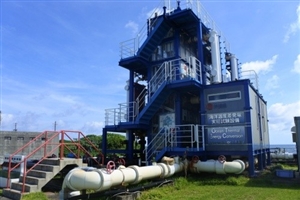
図1●沖縄県の久米島で稼働する海洋温度差発電の実証設備
(出所:日経BP)
「OTEC」とは、表層海水と深層海水の温度差を使って発電する。海深くに潜っていくと水深200m程度で太陽の光はほとんど届かなくなり、約1000mの深海では年間を通じて海水温は4~5℃と冷たく保たれている。一方、太陽が照り付ける海水面は、沖縄近海で約26度、ハワイなど赤道近くでは年間平均で約30℃と温かい。
久米島のOTEC実証設備では、沖合2.3kmの水深612mの海底から汲み上げた8~9℃の深層水と、約26℃の表層水との温度差を利用する。低沸点の作動流体を表層水で気化させ、その膨張する力でタービンを回
して発電し、その気体を5℃の深層水で冷やして再び液体に戻し、それをまた表層水で気化させるーーというサイクルになる(図2)。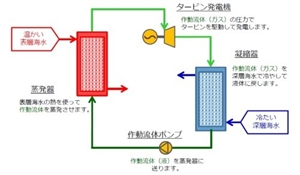
図2●海洋温度差発電(OTEC)の原理
(出所:沖縄県/海洋温度差発電実証設備のパンフレット)
次世代の再生可能エネルギーとして、OTECへの期待が高まっている中、久米島の実証設備は、その実用性を実際の海水で示したとして注目され、運転開始以来、これまでに世界68カ国から1万2000人以上の視察を受け入れている。
OTECは、革命的な要素技術によって実現したわけではない。蒸発器→媒体蒸気→(タービン回転)→凝縮器という循環は、一般的な蒸気タービンによる火力発電と同じだ。これを「ランキンサイクル」という。ランキンサイクルは、化石燃料を燃やして数百℃という高温高圧の蒸気を使えば、環境温度との差が大きく、相対的に効率よく発電できる。だが、20℃程度の温度差では、効率が低く実用にならない。
実際に、海水による温度差で一般的なランキンサイクルの設備を回しても、生み出した電力は深層水を汲み上げるポンプ動力に使われてしまい、正味の電力は得られない。OTECの原理自体は、1880年代にフランスの物理学者が提唱したものの、実用に至らなかったのは、こうした背景があった。
佐賀大の研究者が「ウエハラサイクル」
そうしたなか、1980年代にロシアのカリーナ博士が、作動流体にアンモニアと水の混合媒体を使い、タービンを回した後の気体を作動流体の余熱に使う再生サイクルを加える「カリーナサイクル」を発案し、小さい温度差での発電を可能にした。
1990年代には佐賀大学元学長の故・上原春男氏が、カリーナサイクルを改良し、タービンを2つにして再生サイクルを増やした「ウエハラサイクル」を開発し、もう一段の効率アップに成功した。同氏は、熱交換器の高性能化にも取り組み、チタン製のプレート式タイプを応用して発電設備に採用することで、海水との熱交換効率を上げることに成功した。
佐賀大学では、2003年に佐賀県伊万里市に海洋エネルギー研究所・伊万里サテライトを設置し、出力30kWのOTEC装置を開発し、正味の電力を得られることを実証した。さらに、発電コストの低下に有利な「多段ランキンサイクル」を開発し、国際特許を取得した。多段ランキンサイクルは、作動流体に混合媒体を使わない代わりに、単一媒体のサイクルを複数、組み合わせた。2012年に稼働した久米島の実証設備は、これら佐賀大の知見を実海水に応用したもので、作動流体には代替フロンを採用している(図3)。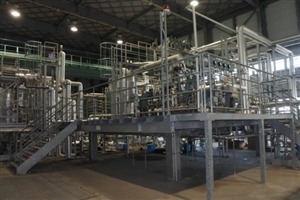
図3●佐賀大学海洋エネルギー研究所・伊万里サテライトにあるOTEC実証設備
(出所:日経BP)
こうした佐賀大学の成果に早くから目を付け、同大と連携してOTECの実用化に取り組んでいるのがゼネシス(東京都江東区)で、伊万里サテライトや久米島の実証プロジェクトにも佐賀大とともに参加している。さらに2022年4月には、久米島のOTEC事業の運営に商船三井が加わった。設備の製造や建設でなく、発電事業自体に民間企業が参画したのは、商船三井が初めてとなる。
久米島の実証設備では、タービン発電機の出力した電力のうち、約4割は、作動流体の循環や、海水を汲み上げるためのポンプ動力に消費されるが、残りの約6割は、「正味出力」として、取り出すことが出来ている。
久米島の実証設備は海岸沿いにあり、全体で3階建てのOTECプラントに白色のパイプと黒色のパイプが引き込まれている。白いパイプには、約600m下の海底から汲み上げられた8~9℃の深層海水、黒いパイプには26℃の表層海水が流れている。白いパイプの一部には、温度センサーを取り付けるために断熱材がない箇所
があり、そこに素手で触るとひんやりと冷たく、表面はうっすらと結露している(図4)。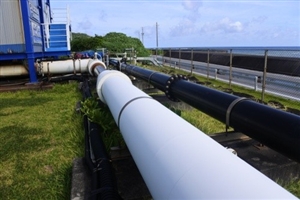
図4●白いパイプには8~9℃の深層海水、黒いパイプには26℃の表層海水が流れている
(出所:日経BP)
発電プラントの2階にチタン製のプレート式熱交換器、3階にタービン発電機がある。実証施設ということもあり、プラント全体を建屋で覆っていない。このため稼働して10年近く経ち、海風による腐食が所々に目立っているが、運用には影響ないという(図5)(図6)。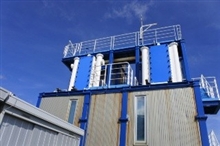
図5●青い2つの板状の装置内にプレート式熱交換器がある
(出所:日経BP)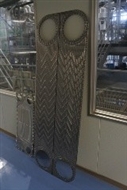
図6●伊万里サテライトに展示されてている熱交換用のプレート部材
(出所:日経BP)
ハワイでも実証設備が稼働
佐賀大学・海洋エネルギー研究所の所長を務める池上康之教授は、「ここにきてOTECの研究開発が世界的に活発化しているが、この状況は第2次ブームとも言える。最近のOTECブームでは、久米島サイトの成功も火付け役の1つになった」と言う。
OTECは1970年代の石油ショック後、欧米や日本で盛んに研究されたが、石油価格の下落とともに90年代には「技術的には可能だが経済性がない」とされ、日本を除き研究が停滞した。だが、2000年代後半から再び研究が活発している。その背景には、「温暖化問題の深刻化で再エネの大量導入が始まるなか、太陽光・風力という変動性再エネのほか、安定して発電できる再エネの価値が高まったことがある」と池上教授は言う。
加えて、工場排熱や温泉熱の有効利用など、低沸点媒体を使ったバイナリー発電が普及段階に入り、小さな温度差で発電するための要素技術が進歩したことも大きい。久米島の実証で、こうした最先端の技術を集大成し、実際の海水で継続的に発電できたことで、OTEC分野の多くの研究者が勇気づけられたという。
2015年8月には、久米島に続き、米国ハワイ州ハワイ島に世界で2基目となる出力105kWの実証設備が稼働した。同州を拠点する海洋関連の建設会社、マカイ・オーシャン・エンジニアリング(Makai Ocean Engineering)が設置した。2045年に電力の再エネ100%を目指すハワイ州では、OTECへの期待が大きい(図7)。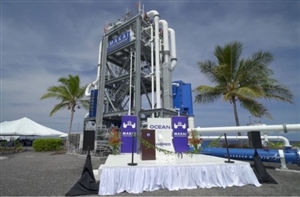
図7●ハワイ島で完成したOTEC実証設備
(出所:Makai Ocean Engineeringのホームページ)
OTECが再び盛り上がるなか、2020年に国際海洋温度差発電協会(Ocean Thermal Energy Association)が設立された。38か国以上の国と地域から研究者や企業、政府機関などが参加し、OTECに関する情報共有と情報発信に取り組んでいる。会長は日本が務める。同協会では毎年開催する国際シンポジウムで、OTECの研究開発で功績のあった研究者に対して「ウエハラ・プライズ」という賞を授与している。OTECの発展に尽力した故・上原春男氏を記念したものだ。
再生可能エネルギー分野では、先端研究や技術開発、機器・設備製造などで日本や日本企業の存在感が年々、低下している。そうしたなかで、OTECは日本が世界をリードしている数少ない再エネ技術とも言える。
将来は10~100MWに大規模化
OTECへの期待が高まる一方で、実用化に向けては、依然として発電コストの高さが大きな壁になっているのも事実だ。
池上教授は、「OTECでは、海洋深層水を汲み上げるための取水管の製造・設置コストが大きく、経済性を高めるには規模のメリットを追求することが不可欠」と強調する。商用化には最低でも出力1MW以上が前提で、現時点の試算では、10MWクラスで20~25円/kWh、ベース電源として10円/kWh以下の発電コストを目指すには、100MWクラスで50億円以上の投資が前提になるという。
大規模化への動きでは海外が先行している。2013年4月に米ロッキード・マーティンは、中国の投資会社と共
同で、10MWの浮体式によるOTECプロジェクトを中国海域に建設すると発表した。同社のロードマップでは、将来的に100MWにスケールアップし、浮体上で水素かアンモニアを製造して船で需要地に運搬するという構想を掲げている。
一方、ハワイでOTEC実証に取り組むマカイ・オーシャン・エンジニアリングは、商用向けに100MW規模の浮体式プラントを構想しつつも、熱交換器の進歩により10MW規模の設備でも利益を上げられる、との試算を公表している(図8)。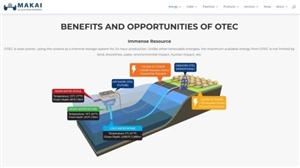
図8●ハワイで構想されている浮体式のOTEC
(出所:Makai Ocean Engineeringのホームページ)
海洋深層水で養殖業が発展
スケールメリットによる発電コストの低減を志向しつつも、別のアプローチで経済性を高めようとの動きもある。池上教授は、「海洋深層水は、発電以外にも利用できるため、複数用途を前提に取水管の敷設コストを分担していけば、コストは大幅に下がる」と話す。
実は、久米島のOTECプロジェクトも、そうした発想からスタートした。久米島では、OTEC設備が稼働する10年以上前から日量1万3000tもの海洋深層水を汲み上げ、海ブドウやクルマエビの養殖に活用していた。
OTECの設備は、沖縄県の運営する「海洋深層水研究所」に隣接しており、発電設備に海水を引き込んでいるパイプは、同研究所にある海洋深層水の貯水タンクからつながっている。海底600mから汲み上げられた深層水はまずこのタンクに貯められ、養殖場やOTEC設備に供給されている。
200m以深の海洋深層水は、年間を通じて温度が低いことのほか、植物プランクトンが生息できないため、無機塩類(窒素、リン、ケイ素)など栄養分が多く、雑菌がほとんどいないなど清浄性が高い。こうした特性は、陸上養殖や食品・化粧品製造に向いている。
海洋深層水研究所の周辺には、クルマエビや海ブドウの養殖場が集積しており、これら久米島の「深層水産業」は、約25億円の生産規模まで成長している(図9)。
図9●久米島では海洋深層水を使った海ブドウの養殖が盛ん
(出所:photoAC)
藻の栽培やカキの陸上養殖も
こうした深層水産業とOTECでは、深層水を奪い合うことはなく、温度帯によって多段利用できる。養殖や食品製造には、OTECに使用した後の11℃程度の深層水も使用できる。実際、久米島の実証設備では、発電に利用した後の深層水を養殖場などに送って再利用している。
久米島では、深層水の用途をさらに拡大すべく、海洋深層水研究所の周辺に複数の企業が研究施設を設けている。ロート製薬は、深層水の冷熱を生かして栽培する「野菜工場」と、清浄性と富栄養性を生かした「藻類の培養」に取り組んでいる。暑さに弱い葉物野菜の中には、沖縄など南国では栽培が難しいものも多いが、海洋深層水で温度を下げることで栽培できる。また微細藻類は、食品原料のほか、色素や機能性素材、養殖魚の種苗生産時の餌料や家畜飼料など応用範囲は広いという。(図10)(図11)。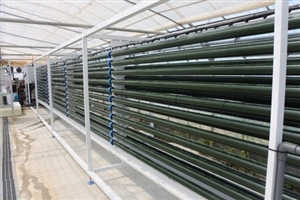
図10●ロート製薬が久米島で運用する藻の培養設備
(出所:日経BP)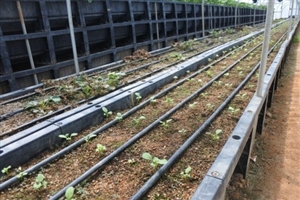
図11●ロート製薬が久米島で運用する、深層水の冷熱を使った野菜工場
(出所:日経BP)
また、牡蠣(カキ)料理のチェーンレストラン「オイスターバー」を全国的に展開するゼネラル・オイスター(東京都中央区)は、世界初となるカキの陸上養殖に挑戦している。清浄性の高い深層水を活用することでより安全なカキを陸上で安定的に生産できる可能性がある(図12)。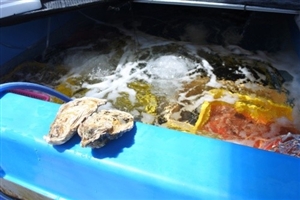
図12●ゼネラル・オイスターが久米島で取り組むカキの陸上養殖
(出所:日経BP)
さらに、佐賀大・伊万里サテライトでは、OTECに利用した後の約11℃の深層水を再利用して海水を淡水化するシステムに取り組んでいる。減圧した密閉空間で海水を蒸発させる海水淡水化装置とOTECを組み合わせる「ハイブリッドOTECサイクル」で、温度差をすべて電気に変えるのに比べ、発電量は減るが、その分、淡水が得られる。
久米島のOTEC設備を運営・管理を担当しているゼネシスの岡村盡OTECエンジニアリング部部長は、「久米島は地下水が豊かで淡水のニーズはほとんどないが、離島によっては電気より水の方が貴重というケースもあり、深層水の利用方法は、地域によって異なる」と話す。「久米島では、海洋深層水を新事業に生かそうという意欲的な複数の企業が研究拠点を設けており、互いに刺激し合いながらノウハウを蓄積している。深層水をエネルギーとして利用しつつ、今後、さらに幅広い産業が集積していく方向が見えてきた」と言う。
OTECをメガ規模に増設
久米島の久米島町では、2050年までに温室効果ガスの排出をなくす「ゼロカーボンシティ宣言」を、2021年1月に公表した。同町のエネルギービジョンでは、2040年までに島内で消費されるエネルギーをすべて再エネに転換することを掲げている。そのための柱がOTEC、そして太陽光発電だ。
同町では今後、OTEC設備をスケールアップし、2025年に1MW、2035年には6MW規模に増強することを目指している。OTECがベース電源を担い、昼の需要増分を太陽光発電で賄うイメージだ(図13)(図14)。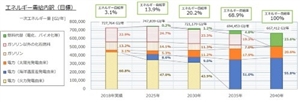
図13●久米島町における再エネ100%への電源構成シナリオ
(出所:久米島町エネルギービジョン2020)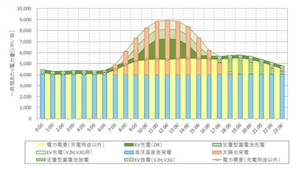
図14●2035年における日間の電力需給バランスシミュレーション
(出所:久米島町エネルギービジョン2020)
同島では2016年、貯水池に面して389kWの太陽光発電設備を町が設置した。さらに昨年2月には、地域資本で久米島未来エネルギー(久米島町)が設立され、オンサイト型PPA(電力購入契約)モデルによって、住宅に太陽光と蓄電池を初期投資ゼロで導入できるサービスを提供し始めた(図15)。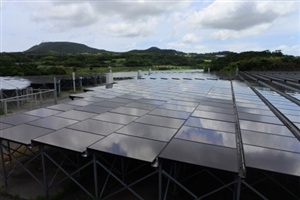
図15●久米島で稼働する大規模な太陽光発電所
(出所:日経BP)
一方OTECを現在の100kWから6MWまで増設するには、深層水をさらに多く取水することが不可欠になる。現在の取水量は日量1万3000tで、全国的にも最大の取水量になるが、それでも、養殖産業などの拡大で、すでに使い切っている。
そこで、町では、深層水の取水量を10倍に増やすことを目指している。これが実現すれば、OTEC設備も1MW、そして6MWへの増強が可能になる。
久米島町の中村幸雄副町長は、「海洋深層水を、OTECと養殖事業などで多段階に利用することで、温室効果ガスが減るとともに、町の産業が発展する。町と企業がウィン・ウインになって島全体が活性化できる」と期待している。
<訳文>
PDFファイルはこちらから→Click here for a PDF file.
Expectations growing for ocean-thermal energy conversion in harmonious relationship with agriculture and fishery
Kumejima's 100-kW plant in continuous operation for decade, drawing global attention
By Kenji Kaneko, Clean Tech Lab, Nikkei BP Intelligence Group | Sep 19, 2022 5:00 AM
International observation parties from 68 countries
Kumejima, Okinawa Prefecture is an isolated island on the East China Sea, 100 kilometers off to the west from Naha City. The area of 63.65 km2 is home to approximately 8,000 people. Highly cultivated with sugarcane, taro and other crops, and blessed with rich fishing grounds provided by the Kuroshio Current as well, the island has also experienced recent development in culture of prawns and others.
The world's first ocean-thermal energy conversion (OTEC) system was put into operation in the island in June, 2012. It is said that Okinawa Prefecture, with the cooperation of Saga University, built a demonstration facility with a capacity of 100 kW, which became the world's first facility to successfully generate electric power by using direct seawater. The facility is on its ninth year since the commencement of operation, and still operating smoothly (Figure 1).
Figure 1 ● Ocean-thermal energy conversion demonstration facility operating in Kumejima, Okinawa Prefecture
(Source: Nikkei BP)
OTEC is a system that utilizes the temperature differential between the surface and deep seawater to generate electric power. A deep diving into the sea finds that almost no sunlight reaches at depths of 200 meters or so in water, and in the depths of the sea, approximately at a depth of 1,000 meters, the seawater temperature stays as low as 4 to 5°C throughout the year. On the other hand, with the sun blazing down, seawater surfaces are warm; their approximate temperatures are 26°C in waters off Okinawa, and their annual average temperatures are approximately 30°C in areas near the equator such as Hawaii.
The OTEC demonstration facility in Kumejima utilizes the temperature differential between the deep water of 8 to 9°C pumped from the ocean floor at a depth of 612 meters, 2.3 kilometers off shore, and the surface water of approximately 26°C. The facility operates in such a cycle that the surface water vaporizes a low-boiling-point working fluid, with the force of its expansion spinning the turbine to generate electric power, and that then deep water of 5°C cools the vapor, turning it back into liquid that is to be vaporized by the surface water again (Figure 2).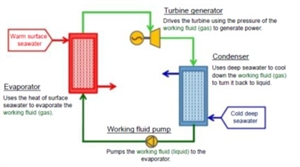
Figure 2 ● Principle of ocean-thermal energy conversion (OTEC)
(Source: Okinawa Prefecture's brochure on ocean-thermal energy conversion demonstration facility)
With rising expectations for OTEC, which is regarded as a next-generation renewable energy source, the demonstration facility in Kumejima has been visited by not less than 12,000 observers from 68 countries worldwide since the operation commencement as it has been attracting attention as a facility that has showcased the practical utility of the system with the direct use of seawater.
It is not an innovative underlying technology that made OTEC feasible. The cycle, which is composed of the evaporator, the vapor of a medium, (turbine spins), and then the condenser, is the same as the cycle of typical thermal power generation with steam turbines. This is called a Rankine cycle. In Rankine cycles, the use of high-temperature, high-pressure steam of several hundred degrees centigrade generated by burning fossil fuels causes a large difference from the ambient temperature, leading to relative efficiency in power generation. However, a temperature differential of 20°C or so results in low efficiency and does not make the system practical.
In fact, running a typical Rankine-cycle plant with the use of temperature differentials created by seawater ends up with no net power obtained because the power generated is used to power the pump for drawing deep water. Against this backdrop, OTEC had not been put into practical use although its principle had already been proposed in the 1880s by a French physicist.
Uehara Cycle by researcher at Saga Univ.
Under these circumstances, in the 1980s, Dr. Kalina in Russia devised a cycle that used a mixed medium of ammonia and water as a working fluid and involved an additional regenerative cycle to preheat the working fluid with the use of the vapor that had spun the turbine. This was called the Kalina cycle, and made it feasible to generate power with a small temperature differential.
In the 1990s, the late Haruo Uehara, a former President of Saga University, developed an improved version of the Kalina cycle. This Uehara cycle, with two turbines and an increase in the regenerative cycle, successfully further increased efficiency. He was also engaged in the development of a heat exchanger with higher performance, and successfully increased efficiency in the exchange of heat with seawater by adopting an applied titanium plate-type heat exchanger in the generating facility.
In 2003, Saga University established the Imari Satellite of the Institute of Ocean Energy in Imari City, Saga Prefecture, and developed an OTEC system with a capacity of 30 kW as a demonstration of the feasibility of obtainment of the net power. Furthermore, the institute developed the multi-stage Rankine cycle, which facilitated reductions in power generation costs, and obtained an international patent. The multi-stage Rankine cycle was a combination of two or more cycles of a single medium, without the use of mixed media in the working fluid. The demonstration facility in Kumejima was put into operation in 2012 as an application of these findings obtained by Saga Univ. on the actual seawater, with a CFC substitute adopted as the working fluid (Figure 3).
Figure 3 ● OTEC demonstration facility located in Imari Satellite of Institute of Ocean Energy, Saga University
(Source: Nikkei BP)
Having had their eyes on these results achieved by Saga University in the early phase, Xenesys in Koto Ward, Tokyo has collaborated with the university to put OTEC to practical use. They have also jointly worked on the demonstration projects in the Imari Satellite and Kumejima. Since April, 2022, Mitsui O.S.K. Lines has also joined the running of the OTEC business in Kumejima. Mitsui O.S.K. became the first private enterprise to participate in a power generation business itself, not in the manufacturing or construction of the facility.
The demonstration facility in Kumejima has been capable of taking approximately 60 percent of the electric power generated by the turbine generator as the net output, with the remaining approximately 40 percent consumed for circulating the working fluid and as power for pumping seawater.
Situated beside the coast, the demonstration facility in Kumejima is a three-story OTEC plant with white and black pipes installed. The deep seawater of 8 to 9°C that has been pumped from the ocean floor approximately 600 meters below the surface is running through the white pipe, while through the black pipe, the surface seawater of 26°C is flowing. For the installation of the temperature sensor, a part of the white pipe remains without a heat insulator. The part is chilly to the touch with bare hands, with its surface covered with a thin film of condensation (Figure 4).
Figure 4 ● White pipe through which deep seawater of 8 to 9°C is running, and black pipe through which surface seawater of 26°C is flowing
(Source: Nikkei BP)
The second floor of the generation plant accommodates titanium plate-type heat exchangers, and a turbine generator is located on the third floor. As a demonstration facility, not entirely covered by the building roof and walls, the plant has operated for nearly a decade, with some noticeable scattered corrosion caused by sea breeze, which is said to have no impact on the operation (Figure 5)(Figure 6).
Figure 5 ● Two blue installations that are plate-like in shape contain plate-type heat exchangers
(Source: Nikkei BP)
Figure 6 ● Plate components for heat exchange displayed in Imari Satellite
(Source: Nikkei BP)
Demonstration facility in operation also in Hawaii
Professor Yasuyuki Ikegami, Director of the Institute of Ocean Energy, Saga University says "As OTEC research and development have now become active worldwide, it is also appreciated that the situation is a secondary boom. The Kumejima site's success was one of the factors that sparked off the recent OTEC boom."
Following the oil shocks in the 1970s, researches on OTEC had been actively pursued both in Western countries and Japan, but the fall in oil prices in the 1990s slowed down the researches in countries other than Japan because OTEC was regarded as technically feasible but not cost-effective. But the researches began to be active again in the late 2000s. The background "includes that the commencement of the large-scale introduction of renewable energy due to the global warming issue, which had become even more serious, raised the value of renewable energy sources that provide stable power generation as well as variable renewable energy sources like solar and wind power," says Professor Ikegami.
In addition, the growth of the binary-cycle power generation using a low-boiling-point medium, such as effective utilization of exhaust heat from plants and hot springs' heat, to a stage of proliferation and the progress in the underlying technology for enabling power generation with a small temperature differential are also major factors. He says that the success in Kumejima, a demonstration of the capability of continuous power generation by direct seawater as a result of a compilation of such cutting-edge technologies, encouraged many researchers in the OTEC field.
After the facility in Kumejima had started operating, in August, 2015, the world's second demonstration facility was put into operation with a capacity of 105 kW in the Island of Hawaii, the state of Hawaii in the United States. The facility was installed by Makai Ocean Engineering, an ocean-related construction company based in the state of Hawaii. The state is aiming to use 100 percent renewable energy for electric power by 2045, with high expectations for OTEC (Figure 7).
Figure 7 ● OTEC demonstration facility completed in Island of Hawaii
(Source: Makai Ocean Engineering's website)
In 2020, with OTEC emerging again, the Ocean Thermal Energy Association was established. With participation by researchers, enterprises, governmental organizations, and others from not less than 38 countries and regions, the association is committed to sharing and disseminating information on OTEC, and chaired by Japan. The association holds an annual international symposium where a researcher who has made achievements in OTEC research and development is awarded the Uehara Prize. The prize is awarded in memory of the late Haruo Uehara, who worked to promote development of OTEC.
In the field of renewable energy, Japan and Japanese enterprises are reducing their presence year after year in terms of advanced researches, technological development, manufacturing of equipment and facilities, and others. However, OTEC can be viewed as one of a small number of renewable energy technologies in which Japan leads the globe.
To be enlarged to 10-to-100-MW scale in future
While expectations for OTEC are growing, it is also a fact that the high cost of generating power remains a high hurdle preventing practical use.
Professor Ikegami stresses that it costs so much to manufacture and install the intake pipe for pumping deep ocean water, which makes pursuing economies of scale essential to increase economic efficiency in OTEC. According to him, commercialization requires a capacity of at least 1 MW, and current estimates are that 10-MW-level power generation costs 20 to 25 yen per kWh, and that in order to aim to reduce the generation cost to 10 yen per kWh or lower for the base-load power source, an investment of five billion yen or more in 100-MW-level power generation will be required.
Japan is behind other countries in moving towards larger scales. In April, 2013, Lockheed Martin in the U.S. announced its joint OTEC project with an investment company in China to construct a 10-MW floating offshore system off the coast of China. Its roadmap presents the design concept of increasing the scale to 100 MW in the future, including ships transporting hydrogen or ammonia produced on the floating system to places in need.
On the other hand, Makai Ocean Engineering working on OTEC demonstration in Hawaii, having developed its design concept of a 100-MW-scale floating plant for commercial use, has revealed its estimates that advanced heat exchangers will make it possible even for a 10-MW-scale facility to achieve profitability (Figure 8).
Figure 8 ● Floating OTEC system being planned in Hawaii
(Source: Makai Ocean Engineering's website)
Deep ocean water leading to development of culture industry
Attempts are also being made to increase economic efficiency by combining efforts to reduce generation costs through economies of scale with another approach. "Since the uses of deep ocean water are not limited to power generation, sharing the costs of laying the intake pipe with multiple uses assumed allows a significant reduction in power generation costs," says Professor Ikegami.
Actually, the OTEC project in Kumejima also began with such an idea. In Kumejima, before the OTEC facility started operating, thirteen thousand tons of deep ocean water a day had been pumped and utilized for the culture of sea grapes and prawns for over a decade.
The OTEC facility is adjacent to the Deep Sea Water Research Center under the management of Okinawa Prefecture, and the pipe leading seawater to the power generation facility is connected from the water storage tank located in the research center for storing deep ocean water. Having been pumped from the ocean floor 600 meters down, the deep water is stored in this tank before being supplied to culture farms and the OTEC facility.
At depths of 200 meters and beyond, the temperature of deep ocean water is low throughout the year. In addition, phytoplankton cannot inhabit these deep ocean waters, which makes the water rich in nutrients such as inorganic salts (nitrogen, phosphorus, and silicon) and high in purity and cleanliness, e.g., with almost no bacteria. These characteristics make the water suited for inland aquaculture and production of foods and cosmetics.
With a concentration of prawn and sea grape culture farms around the Deep Sea Water Research Center, such deep water industries in Kumejima have grown to reach a production scale of approximately 2.5 billion yen (Figure 9).
Figure 9 ● In Kumejima, sea grape culture is active with deep ocean water utilized
(Source: photoAC)
Also for algae cultivation and inland oyster aquaculture
For these deep water industries and OTEC, with temperature zones, multi-stage utilization of deep water can be achieved without conflict. For culture and food production, post-OTEC process deep water of approximately 11°C can also be used. Indeed, in Kumejima, the deep water that has been used for power generation in the demonstration facility is sent to culture farms, etc. to be reused.
Aiming to increase the range of uses for deep water, enterprises have their research facilities around the Deep Sea Water Research Center in Kumejima. Rohto Pharmaceutical has developed the vegetable factory where the cooling effect of deep water is utilized for cultivation, and is working on the cultivation of algae, making effective use of the high purity and cleanliness and rich nutrients of deep water. Leafy vegetables are sensitive to high temperatures, making it difficult to grow many of them in tropical regions like Okinawa, but reducing the temperature with deep ocean water enables cultivation of these vegetables. In addition, microalgae are said to have a wide range of applications that are not limited to food materials but include coloring matters, functional materials, feed materials for production of fish fry for culture, and livestock feed. (Figure 10)(Figure 11).
Figure 10 ● Algae cultivation facility operated by Rohto Pharmaceutical in Kumejima
(Source: Nikkei BP)
Figure 11 ● Vegetable factory operated by Rohto Pharmaceutical in Kumejima, using cooling effect of deep water
(Source: Nikkei BP)
Also, General Oyster based in Chuo Ward, Tokyo, a firm rolling out a chain of oyster restaurants, oyster bars, across Japan, is tackling the challenge of becoming the world's first company to successfully culture oysters in an inland aquaculture facility. It may be feasible to achieve stable inland production of safer oysters by utilizing deep water of high purity and cleanliness (Figure 12).
Figure 12 ● Inland oyster aquaculture being carried out by General Oyster in Kumejima
(Source: Nikkei BP)
Further, the Imari Satellite, Saga Univ. is working on a system to desalinate seawater by reusing the deep water of approximately 11°C that has already been used for OTEC. Through the Hybrid OTEC Cycle, which combines the seawater desalination system that evaporates seawater in an enclosed space under reduced pressure and OTEC, although compared to a cycle where all the temperature differentials are converted into electricity, there is a reduction in power generated, fresh water can be obtained instead.
Shin Okamura, the manager of the OTEC Engineering Department, responsible for the administration and management of the OTEC facility in Kumejima says that whereas there is little need for fresh water in Kumejima, which is rich in underground water, there are remote islands where water is more valuable than electricity, and that deep water is utilized differently according to the region. "Enterprises eager to take advantage of deep ocean water to launch a new business have their research centers in Kumejima. They are accumulating expertise, stimulating each other. An approach to the future of the OTEC system has come into view; deep water will continue to be utilized as an energy source with an integration of an ever-wider range of industries," he says.
OTEC facility to be increased to megawatt scale
In January, 2021, Kumejima Town in Kumejima announced its Zero Carbon City Declaration, a commitment to eliminate emissions of greenhouse gases by 2050. The town's energy vision includes its plan to replace all of the energy consumed in the island with renewable energy by 2040. The primary means to achieve this goal are OTEC and solar photovoltaic power generation.
The town is aiming to increase the OTEC facility in scale, to the 1-MW scale in 2025 and to the 6-MW scale in 2035. This is the idea that the base-load power source will rely on OTEC, while daytime increase in demand will be covered by solar photovoltaic power generation (Figure 13)(Figure 14).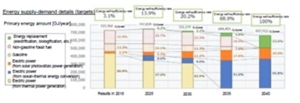
Figure 13 ● Energy mix scenario leading up to 100% renewable energy in Kumejima Town
(Source: Kumejima Town Energy Vision 2020)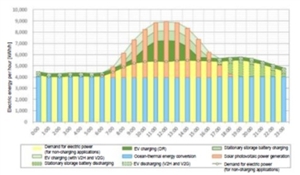
Figure 14 ● Simulation of supply-demand balances of electric power over day in 2035
(Source: Kumejima Town Energy Vision 2020)
In 2016, the town built a 389-kW solar photovoltaic power generation facility fronting the reservoir in the island. Furthermore, in February of last year, Kumejima Mirai Energy (based in Kumejima Town) was founded through regional funds, and began providing service that allows users to introduce the solar photovoltaic power system and storage batteries in their homes on an on-site power purchase agreement (PPA) basis without initial investment (Figure 15).
Figure 15 ● Mega-solar power plant operating in Kumejima
(Source: Nikkei BP)
In the case of OTEC, expansion of the current 100-kW facility to the 6-MW scale requires an even larger amount of deep water to be taken. Currently, the daily amount of water taken is 13,000 t, one of the largest amounts in Japan, all of which has already been consumed for the expansion of industries including the culture industry.
Therefore, the town is aiming to increase the amount of deep water taken ten-fold. Achieving this will allow the OTEC facility to be increased to 1 MW in scale and even to 6 MW.
Deputy Mayor Yukio Nakamura of Kumejima Town expects that they will be able to reduce greenhouse gases through multi-stage utilization of deep ocean water for OTEC, the culture businesses and others, leading to industrial development of the town, and create a win-win situation for the town and enterprises, which will energize the entire island.
<訳者からの連絡事項>
| 原文 | 訳文 | 連絡事項 |
|---|---|---|
| 余熱 | to preheat | 「予熱」を意味すると判断しました。 |